
Hypnobirthing is not a script for a particular kind of birth. It is a set of techniques for managing fear, supporting oxytocin, and staying calm and informed regardless of how your birth unfolds. A hypnobirthing birth plan reflects this: it is less about listing medical preferences and more about establishing the psychological and environmental conditions that let the techniques actually work.
This guide covers how to write that plan for an Australian hospital, including the specific language to use, the three main Australian programs and how they differ, what to include across all three birth scenarios, and how to communicate your preferences to a care team that may or may not be familiar with hypnobirthing.
The fear-tension-pain cycle
Hypnobirthing is built on an insight from British obstetrician Dr Grantly Dick-Read, who described what he called the fear-tension-pain cycle. Fear triggers physical tension. Tension restricts blood flow to the uterus, causing muscles to work against each other and amplifying pain. This creates a self-reinforcing loop. Adrenaline, the fear hormone, overrides oxytocin, the hormone that progresses labour.
Hypnobirthing aims to break this cycle by replacing fear with knowledge, confidence, and deep relaxation. When the body is calm, it produces oxytocin (which drives labour progress) and endorphins (natural pain relief) rather than adrenaline. The techniques taught across all programs, including breathing, self-hypnosis, visualisation, positive affirmations, and anchoring, are tools for keeping the body in this state.
Your birth plan communicates to your care team the conditions that support this state. It is not a demand list. It is an explanation of what you are doing and what you need from your environment.
Why language is not cosmetic
The most distinctive feature of a hypnobirthing birth plan is its language. Words affect the subconscious mind and physical body directly. Medicalised or fear-laden language can trigger the fight-or-flight response, disrupting oxytocin flow. This is why hypnobirthing programs teach specific terminology replacements, and why a birth plan should ask care providers to use them.
| Standard term | Hypnobirthing term |
|---|---|
| Contraction | Surge or wave |
| Pain | Pressure, sensation, intensity, or power |
| Pushing | Breathing down, down breathing, breathing baby out |
| Delivery | Birth |
| Waters breaking | Membranes releasing |
| Dilating | Opening |
| Birth plan | Birth preferences |
| False labour / Braxton Hicks | Practice surges |
Include a language request in your birth preferences. A common version reads: “We are using hypnobirthing techniques and the environment and language are important to us. Please avoid using the words ‘pain’ or ‘contractions’ and instead refer to ‘surges’ and ‘comfort.’ Please do not ask me if I am in pain. You are welcome to ask how I am feeling.”
Some hospitals have already formalised this. Wirral University Teaching Hospital in the UK has published official staff guidance with these language replacements. In Australia, institutional uptake is growing, particularly in WA. But do not assume your hospital has seen this before. Put it in writing.
The three Australian programs: what they are and how they differ
Three programs dominate the Australian market. They are not interchangeable, and the differences matter when you are writing your birth plan.
Hypnobirthing Australia / Hypnobubs ($199 online, $497-$697 face-to-face)
Australia's most popular childbirth education program, founded by clinical hypnotherapist Melissa Spilsted. Hypnobubs is the international/online brand with the same content. The program holds Australia's only legally registered trademark for “hypnobirthing.”
Self-hypnosis is the central technique. Educators are not required to be birth professionals — they complete Hypnobirthing Australia's own certification. The program was adopted by WA Country Health Service across all 19 rural and remote WA hospitals after one year of outcomes data at Bunbury Hospital showed reduced interventions. Hypnobirthing Australia offers a world-first dedicated caesarean birth course ($199) and an Indigenous Birth Program. Health fund rebates may apply for some classes.
Calmbirth ($595 face-to-face)
Founded by Peter Jackson, a registered midwife with 40+ years' experience. Calmbirth is not hypnobirthing. It does not use hypnotherapy or self-hypnosis. Instead, it uses the body's natural physiological relaxation response, breathing, and neuroscience-based education. The distinction matters: if you have done Calmbirth, your birth plan should reflect Calmbirth's approach, which is physiological and education-based, not hypnosis-based.
Calmbirth's key differentiator is that all educators must be practising midwives, doulas, or trained birth professionals. It is accredited by the Australian College of Midwives and integrated into major hospitals including the Royal Hospital for Women in Randwick, Sydney Adventist Hospital, and John Hunter Hospital in Newcastle. Research at the Royal Hospital for Women found Calmbirth participants had a 23% reduction in drug use during labour. No online self-paced course is available.
The Positive Birth Company (~$80 AUD)
Founded by UK-based Siobhan Miller, this is the most affordable option and very popular with Australian parents due to its price and strong online presence. The companion Freya app (~$6.49 AUD) is the world's first hypnobirthing-friendly surge timer, with coaching audio and breathing guidance.
The limitation for Australian parents: the course is UK-centric and does not address Australian models of care (public vs private, MGP, birth centres). Your birth plan will still need to be adapted for the Australian hospital system.
Your hypnobirthing birth preferences: section by section
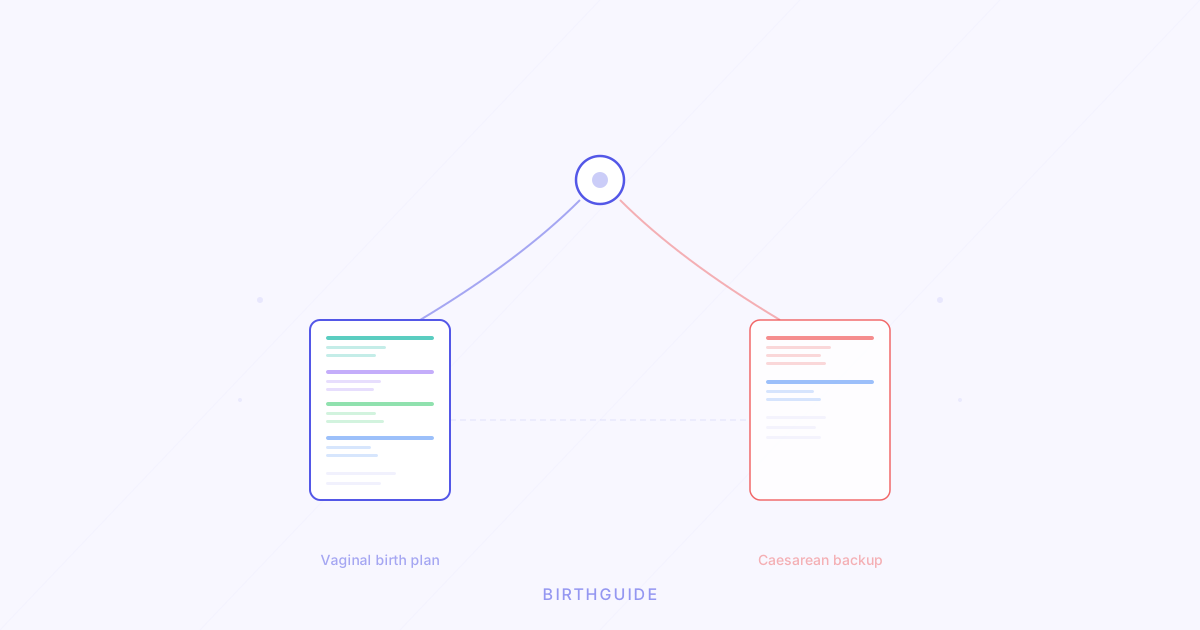
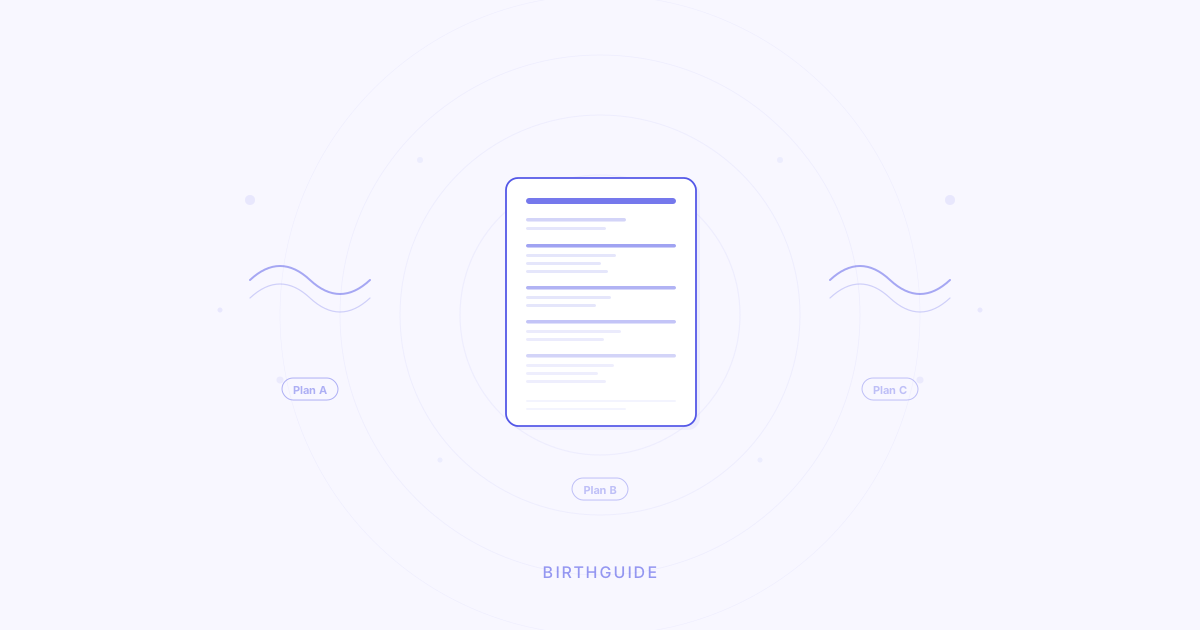
Hypnobirthing birth plans typically cover three scenarios. Plan A is your preferred vaginal birth path. Plan B covers changed circumstances including induction and epidural. Plan C covers caesarean. Writing all three is not pessimism. It is practical preparation, and it signals to your care team that you are informed and flexible.
Environment
Oxytocin is sometimes described as a shy hormone. It thrives in conditions of safety, privacy, warmth, and low stimulation. Your environment preferences create the conditions for it to flow.
Common requests include: dim lighting (drawn curtains, battery-operated fairy lights or tea lights from home, an eye mask if lighting cannot be adjusted), minimal noise (hushed voices, medical conversations held outside the room where possible, no unnecessary talking during surges), and limited interruptions (routine checks performed without verbal interruption where possible, questions directed to your birth partner initially).
Many hypnobirthing parents bring a Bluetooth speaker for relaxation tracks, affirmation audio, or a personal playlist. If you are planning a water birth, a waterproof speaker is worth noting. Aromatherapy is commonly used: lavender is calming and supports oxytocin; clary sage encourages surges and relieves tension (during labour only, not before); peppermint eases nausea; frankincense supports calm breathing. These are used via diffuser, room spray, or cotton wool. The scent used in pregnancy becomes an anchor: smelling it in labour triggers a conditioned relaxation response. Note: lavender should not be used alongside an epidural, as both can lower blood pressure.
Many parents also bring affirmation cards to display, photos, and a familiar pillow or blanket. Your birth partner is the guardian of this environment, managing the space and communicating with the birth team so you can stay in your zone.
Language request
Include a brief, specific language request at the top of your birth preferences. Keep it direct and without apology. Staff who have not encountered hypnobirthing before will read it quickly during a shift handover. One paragraph is enough.
Pain relief
The standard hypnobirthing wording is: “Please do not offer me pain relief. I will ask for it if I need it.” This is fundamentally different from refusing pain relief. The distinction matters enormously.
Being offered pain relief during an intense surge can undermine confidence and break focus at the moment when technique is most valuable. The mother retains full agency to request pain relief at any time. Using it does not contradict or “fail” hypnobirthing. Many practitioners actively teach that embracing pain relief when you need it is itself the right hypnobirthing decision.
Monitoring
Intermittent auscultation with a handheld doppler is preferred over continuous electronic fetal monitoring (CTG), because it allows mobility. Mobility supports labour progress, pain management, and the relaxation that hypnobirthing requires. If continuous monitoring is clinically required, wireless or waterproof monitors should be requested where available.
A useful note to include: “Please be aware that hypnobirthers can progress faster than expected, as deep relaxation may mask outward signs of labour.”
Second stage: breathing baby down
This is one of the strongest preferences in a hypnobirthing birth plan. The standard wording: “I have practised down breathing for the second stage. I do not want to be coached. I would like to follow my body and breathe down when the urge comes.”
Hypnobirthing teaches working with the fetal ejection reflex, the body's natural expulsive urge, rather than coached “purple pushing” (directed breath-holding and forced bearing down, known as Valsalva pushing). Directed pushing can cause maternal exhaustion, perineal trauma, and reduced oxygen to the baby. Mother-directed breathing down allows the reflex to do the work.
Vaginal examinations
Hypnobirthing advocates for minimal vaginal examinations. You can request them only when clinically necessary, and you can decline them entirely. Refusal of any examination is your legal right in Australia under informed consent principles. Some parents request that any dilation figures be framed positively: “Please do not say I am ‘only’ a certain number of centimetres open. Please frame progress positively.”
Third stage and postnatal
Physiological third stage (birthing the placenta naturally without routine syntometrine) is preferred where safe, with active management available as a backup. Delayed cord clamping until the cord stops pulsating or for at least three minutes. Immediate uninterrupted skin-to-skin for the first hour, with weighing, checks, and vitamin K delayed where possible. The calm, dimly lit environment should be maintained through the third stage and beyond.
Your birth partner's role
In hypnobirthing, the birth partner is integral, not peripheral. Their role during labour typically includes: managing the environment (setting up diffuser, music, lighting), providing light touch massage and anchor point touch, communicating with the birth team, reading affirmations aloud, using the BRAINS framework to support informed decisions, and performing acupressure.
BRAINS stands for: Benefits, Risks, Alternatives, Instinct, Nothing (what if we wait?), Smile (are you treating us kindly?). It is the framework for navigating any unexpected decision in labour, taught across all major programs.
Include in your plan: “Please direct questions and updates to my birth partner in the first instance. I am keen to stay in my zone.”
Plan B: induction and epidural
Australia's induction rate reached 33% of all births in 2023 and continues to rise. Hypnobirthing prepares you for induction, not against it. All techniques remain relevant: breathing, affirmations, environment management, and relaxation. The key practical adjustments:
Continuous monitoring is typically required with a syntocinon drip. Request wireless or waterproof CTG monitors if available so you can remain mobile for as long as possible. Syntocinon-augmented surges are often stronger and closer together than spontaneous surges. The hypnobirthing techniques you have practised matter more, not less, in this context.
On epidurals: one practitioner put it plainly, and it is worth repeating verbatim: “If you are planning on using an epidural, hypnobirthing is as important, if not more important, for you.”
Here is why. In most Australian hospitals, epidurals are not available until active labour (around 4cm). Hypnobirthing manages early labour at home and during transit, often the hardest part without any support. During placement, the mother must sit completely still while the anaesthetist works. Breathing and self-hypnosis are invaluable in this moment. After placement, the epidural removes sensation but is not a hormone replacement. Oxytocin production still requires a calm environment. Without active effort to maintain it, the atmosphere in a room often shifts after an epidural: lights come up, chatter increases, privacy decreases. This can stall labour. Hypnobirthing helps prevent this shift.
Note for your birth preferences if using an epidural: omit the lavender aromatherapy request, as lavender and epidural anaesthesia can both lower blood pressure.
Plan C: caesarean birth
Over one in three Australian births are by caesarean. Every hypnobirthing birth plan needs a caesarean section. Not as a reluctant footnote, but as a fully considered set of preferences.
The concept of a “gentle” or “family-centred” caesarean was developed by Professor Nicholas Fisk, now based at the University of Queensland, in a landmark 2008 paper. It aims to mimic vaginal birth conditions as closely as possible during surgery. Hypnobirthing techniques remain powerful in theatre. Breathing manages anxiety in a busy, unfamiliar environment. Visualisation provides mental escape. Affirmations specific to caesarean birth build confidence. Anchoring scents on the wrists or on cotton wool provide comfort. The birth partner's touch continues its role.
Key caesarean preferences for a hypnobirthing birth plan:
- Drape options: request a lowered or clear drape so you can see your baby being lifted out. Not all Australian hospitals offer this. Ask your obstetrician at a pre-surgery antenatal appointment. See our full caesarean birth plan guide for detail on drape choices.
- Slow delivery: request that your baby is delivered slowly, allowing the chest to be gently squeezed as during vaginal birth, helping clear fluid from the lungs.
- Immediate skin-to-skin in theatre: monitors repositioned to sides or toes. Baby placed directly on your chest as soon as stable. Partner available for skin-to-skin if you are unable.
- Delayed cord clamping: until the cord stops pulsating or for at least three minutes.
- Own music playing in theatre: bring a playlist and a small Bluetooth speaker.
- Quiet atmosphere: request that non-essential conversation in theatre is minimised, and that the birth moment itself is calm and unhurried.
- Breastfeeding initiated in theatre where possible.
- IV access in the non-dominant arm, not the hand: this allows you to hold your baby more comfortably.
- Partner present throughout, including during the spinal anaesthetic if the hospital allows.
Hypnobirthing Australia's dedicated caesarean birth course covers all of this in depth. If you are planning a caesarean, or want to be prepared for the possibility, it is worth completing alongside the main program.
Communicating your plan with your care team
Discuss your birth preferences at an antenatal appointment at least two to three weeks before your due date. Your midwife or obstetrician can confirm which requests are supported by your specific hospital, flag anything that needs adjustment, and make notes in your file.
Write the word “hypnobirthing” clearly on your birth preferences. Some hospitals will allocate a midwife who is familiar with hypnobirthing or sympathetic to it. It costs nothing to ask.
If your care provider seems unfamiliar or uncertain, frame the conversation practically. The core requests are straightforward: dim the lights, keep the room quiet, do not offer pain relief unless asked, avoid coached pushing in the second stage. These are not unusual preferences. They are clinically sound and increasingly mainstream.
Bring printed copies. Share a digital version before you arrive in labour. Your birth partner should have a copy and should read it thoroughly before the day.
What the evidence actually says
The honest position on the research: rigorous randomised controlled trial evidence for hypnobirthing specifically is limited. Studies are small, methods vary, and most research tests brief hypnosis interventions rather than comprehensive multi-week programs. Drawing direct conclusions is difficult.
The strongest evidence supports psychological benefits: reduced fear of birth, increased confidence, better birth satisfaction, and lower antenatal depression. A 2024 systematic review found positive effects on anxiety and fear of birth. A 2025 systematic review found the majority of studies showed hypnobirthing reduced antenatal depression. These are meaningful outcomes regardless of any effect on clinical interventions.
Australian observational data is promising. At Bunbury Hospital in WA, one year of outcomes data comparing Hypnobirthing Australia attendees with non-attendees showed reductions in non-elective caesareans, morphine use, epidurals, and inductions. This led WA Country Health Service to adopt the program across all 19 rural and remote hospitals. Research at the Royal Hospital for Women in Sydney found Calmbirth participants had a 23% reduction in drug use during labour and reduced medical interventions across all birth types, including caesarean. A 2016 study from Western Sydney University found complementary techniques including relaxation, breathing, and meditation significantly decreased interventions for first-time Australian mothers.
The 2016 Cochrane Review of nine RCTs and 2,954 women found no significant overall differences in pharmacological pain relief or spontaneous vaginal birth. However, when hypnosis was compared specifically to supportive counselling (rather than no treatment), the hypnosis group was less likely to use pharmacological analgesia and more likely to have a spontaneous vaginal birth. All evidence was graded low quality.
The most honest framing for any parent: hypnobirthing is unlikely to guarantee a specific clinical outcome. It is likely to improve your experience of birth, reduce fear, and give you a richer set of tools for managing whatever happens. That is a reasonable outcome to pursue.
Create your birth plan
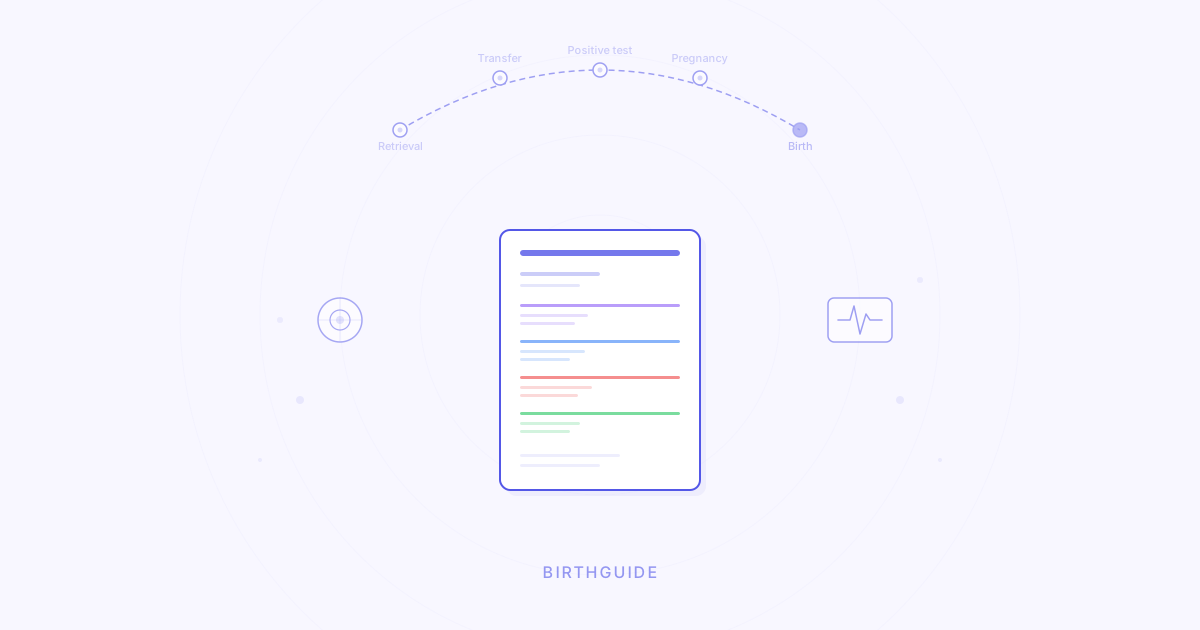
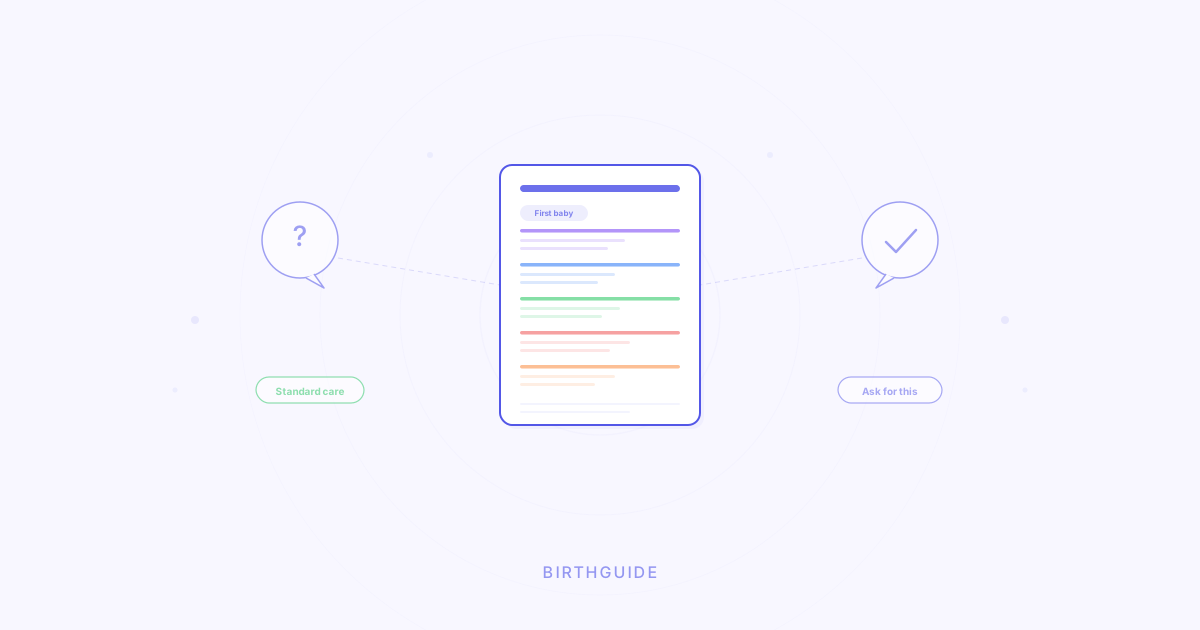
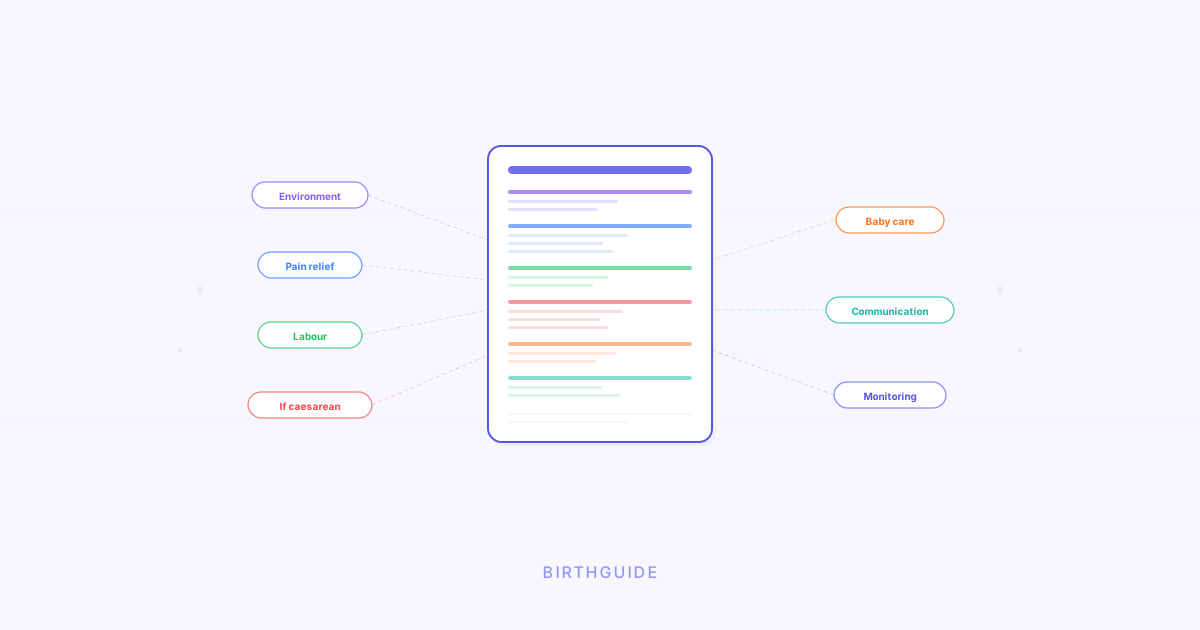
BirthGuide's questionnaire covers the preferences that matter most in a hypnobirthing birth plan: environment and lighting, language preferences, whether to be offered pain relief, monitoring choices, second-stage approach, your birth partner's role, and your caesarean preferences. It generates a one-page colour-coded document your care team can scan in seconds, and a separate partner cheat sheet for active labour.
Create your birth plan