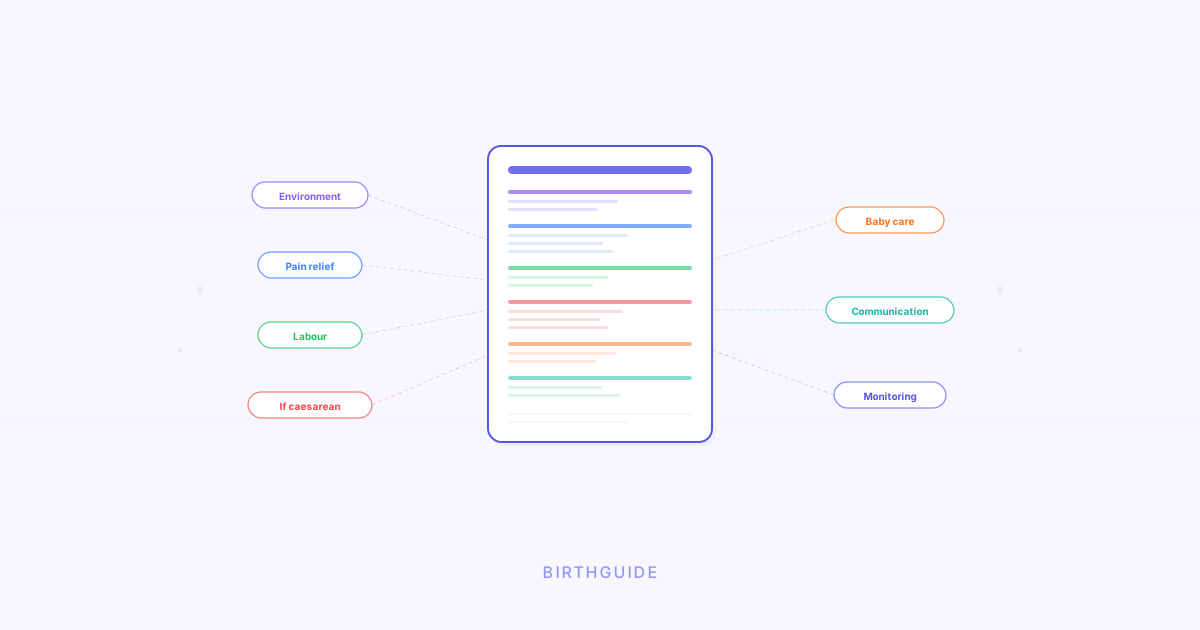

A birth plan is a short document that tells your care team what matters to you during labour and birth. It covers things like how you want to manage pain, who you want in the room, what happens in the first moments after your baby arrives, and what you would prefer if things change direction.
The reason it matters in Australia specifically is that in most public hospitals, the midwife and doctor you meet during labour will not be the same people you saw during pregnancy. Your birth plan is how they learn your preferences in the minutes after you arrive, not over months of appointments. Even in private care, where you have an ongoing relationship with your obstetrician, the midwives providing hands-on labour support are meeting you for the first time.
Writing a birth plan does not mean you are trying to control something unpredictable. It means you are giving your care team a head start on understanding what matters to you, so they can support you better when it counts.
When to write your birth plan
Most parents write their birth plan between 32 and 36 weeks. Early enough that you have time to research your options and discuss them with your care team. Late enough that your preferences feel grounded in the reality of your pregnancy rather than abstract ideas from the first trimester.
If you are having a planned caesarean with a scheduled date, aim for at least three weeks before. You will want to discuss the document with your obstetrician at a dedicated appointment.
If you are reading this at 38 weeks and have not started, that is fine. A birth plan written in an hour is better than no birth plan at all. BirthGuide's questionnaire generates a complete document from your answers.
What to include
A birth plan does not need to be long. In fact, shorter is better. Your midwife will scan it during a busy shift, not sit down and read it like a letter. One page is ideal. Two pages is the maximum before important details start getting missed.
Here is what belongs in that page, section by section.
Your details and birth team
Your name, your partner's name and phone number, your due date, your hospital, and your care provider (obstetrician, midwife team, or GP). If you have a doula or additional support person, include their name and contact details.
This section exists because the person reading your birth plan may not know who you are. It orients them immediately.
Who you want present during labour and birth
Your partner, a family member, a doula, or a combination. Most Australian hospitals allow one to two support people during vaginal birth and one during caesarean. Check your hospital's policy and note your preference.
If you have a view on medical students or student midwives observing, note that too. You have the right to decline.
Birth environment
The atmosphere in your birth room affects how your body responds to labour. Oxytocin, the hormone that drives contractions, flows best when you feel safe, private, and undisturbed. Adrenaline, which your body produces in response to stress, works against it.
Preferences to consider: lighting (dim or low), music (your own playlist or relaxation tracks), temperature, noise level (quiet voices, minimal interruptions), aromatherapy, and whether you want the door kept closed. These are not luxury requests. They are practical conditions that support your body's physiology.
If you are using hypnobirthing or calmbirth techniques, your environment preferences will be more specific. Include a note about language preferences (using “surges” instead of “contractions,” for example) and ask staff not to offer pain relief unless you request it.
Pain management
This is the section most parents spend the most time on, and it is worth thinking through carefully. Your options in Australia include gas (nitrous oxide), pethidine or morphine, epidural, sterile water injections, TENS machine, and non-pharmacological methods like breathing techniques, heat packs, shower or bath, massage, birth ball, and movement.
You do not need to commit to one approach. Many parents write something like: “I would like to start with non-pharmacological methods and am open to gas if needed. I would prefer not to have an epidural unless I request one.” That gives your care team a clear starting point while leaving room for things to change.
Two things worth noting for Australian hospitals specifically. First, epidurals are available in most hospitals but an anaesthetist may not be immediately available, especially in public hospitals overnight. If rapid access to an epidural is important to you, mention it. Second, TENS machines are not provided by most hospitals, so you will need to hire or buy one beforehand and bring it with you.
If your approach is “I will decide during labour,” that is also a valid preference. Write it down so your team knows you are informed and making a deliberate choice, not simply unsure.
Monitoring
How your baby's heart rate is monitored during labour affects your mobility and comfort. The two main approaches in Australia are intermittent auscultation (a handheld doppler used at regular intervals, allowing you to move freely between checks) and continuous electronic monitoring (a CTG belt around your abdomen, which can restrict movement unless wireless monitoring is available).
For low-risk pregnancies, Australian guidelines support intermittent monitoring. For higher-risk situations, including induction and VBAC, continuous monitoring is usually required. Your birth plan should note your preference and whether you would like wireless monitoring if continuous is needed.
If you are planning a VBAC, monitoring is one of several specific considerations. Our VBAC birth plan guide covers these in detail.
Labour and pushing
Your preferences for how the second stage of labour unfolds. Key decisions include your preferred positions for pushing (upright, side-lying, squatting, on all fours, in water), whether you want coached pushing or prefer to follow your body's urges, and your preferences around assisted delivery (forceps or vacuum) if it becomes necessary.
Other options to note: whether you would like to touch your baby's head during crowning, whether you want a mirror to see the birth, and whether you would like warm compresses on your perineum (standard practice in many Australian hospitals to reduce tearing).
Third stage (after baby is born)
The third stage of labour is the delivery of the placenta. You have two options: active management (an injection of syntocinon to speed up the process, which is standard practice in most Australian hospitals) or physiological management (waiting for the placenta to deliver naturally, which takes longer but avoids medication).
Also note your preference for cord clamping. Delayed cord clamping (waiting at least one to three minutes or until the cord stops pulsating) is now recommended by Australian guidelines and is routine in most hospitals, but it is worth including if it is important to you. If you are planning cord blood banking, note this so the team can coordinate.
If you want to keep your placenta, include this and check your hospital's policy beforehand. You will need to bring an insulated container.
Baby's first moments
Your preferences for the minutes and hours after birth. This section covers skin-to-skin contact (on your chest or your partner's if you are unable), how long you want uninterrupted bonding time before routine checks (weighing, measuring, vitamin K), your feeding preferences (breastfeeding, formula, or combination), and who stays with baby if you need to be separated.
Vitamin K injection and hepatitis B vaccination are offered to all newborns in Australia. Your birth plan can note your preference, and the hospital will ask for your written consent before administering either.
If you have chosen not to find out your baby's sex, note who you would like to announce it. This avoids someone in the room accidentally sharing the surprise.
If things change direction
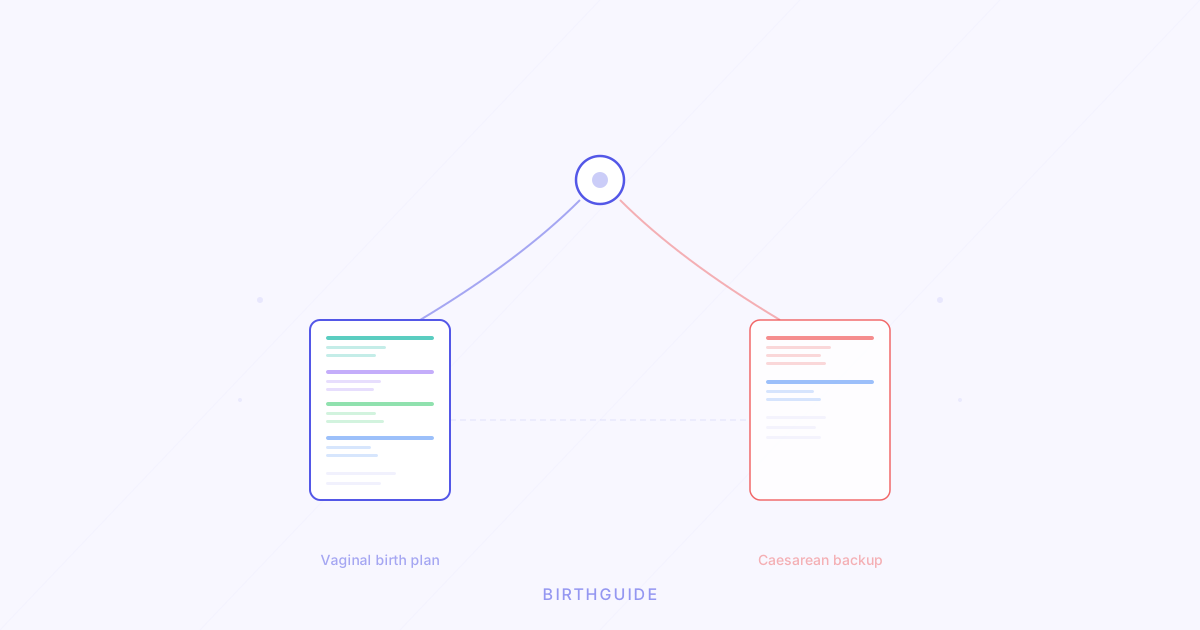
This is the section most birth plans handle poorly, and the one that matters most when it counts. If you are planning a vaginal birth, include your preferences for a caesarean in case one becomes necessary. If you are planning a caesarean, include what you would want if a vaginal birth becomes the recommendation.
For a caesarean backup, cover who you want in theatre, drape preferences (standard, lowered, or clear), skin-to-skin in theatre, delayed cord clamping, music, and anything else that matters to you. Our caesarean birth plan guide covers these preferences in detail.
The point of this section is not to plan for failure. It is to make sure you still have a voice if the path changes. Parents who have thought through their caesarean preferences in advance consistently report feeling more in control and more positive about their birth experience, even when it was not what they originally planned.
Communication preferences
How you want your care team to communicate with you during labour. Common preferences include having interventions explained before they happen, being given time to ask questions before procedures, and specifying who should make decisions on your behalf if you are unable to. If you have language or communication needs, or if you would like an interpreter, note this.
The BRAINS framework (Benefits, Risks, Alternatives, Instinct, Need to do it now, Space to decide) is a useful tool for making decisions during labour. Some parents include a note asking their care team to walk through this framework before any intervention.
How your hospital affects your birth plan
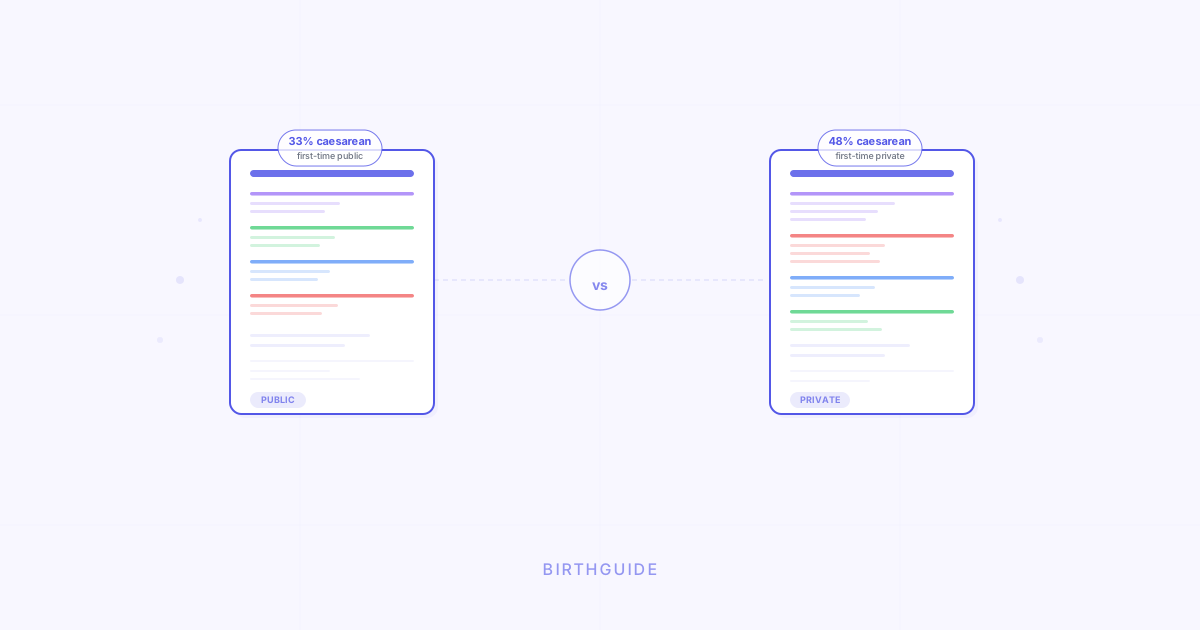
Where you are giving birth changes which preferences are realistic and which need extra emphasis. A birth plan for a public hospital serves a different function than one for a private hospital, and both differ from a birth plan for a birth centre.
In public hospitals, your birth plan is often the first and only communication your midwife has about your preferences. Standard public care means you see rotating staff during pregnancy and meet your birth team for the first time in labour. Your plan needs to be clear, specific, and scannable. If you are in a Midwifery Group Practice (MGP) program, your named midwife already knows your preferences through ongoing conversation, but a written plan still helps when backup staff are involved.
In private hospitals, you have an ongoing relationship with your obstetrician who knows your preferences from months of appointments. But the midwives providing labour support are still meeting you for the first time. Your plan serves them. Also worth knowing: intervention rates, including caesarean and epidural rates, are statistically higher in private hospitals. If avoiding intervention is important to you, your birth plan needs to be explicit about this.
In birth centres, the philosophy already aligns with minimal intervention, so your plan can focus on the specifics: water birth preferences, who is present, third stage management, and what happens if you need to transfer to the main hospital.
Our guide to public vs private hospital birth plans breaks down the specific differences and what to include for each setting.
What your birth plan should look like
Format matters as much as content. A beautifully written two-page letter will not get read during a busy shift change. A colour-coded, one-page document with clear headings and short statements will.
Use headings for each section. Use short phrases or single sentences, not paragraphs. Colour-coding helps your care team find the relevant section quickly: one colour for your primary birth preferences, another for your caesarean backup, another for baby care.
Your partner should have their own copy. During active labour, your partner is often the one referencing the plan when the midwife asks a question and you are mid-contraction. A one-page summary of the key points, separate from the full plan, makes this easier. Think of it as a cheat sheet for the delivery room.
BirthGuide generates all of this automatically. You answer the questions, and it produces a one-page colour-coded birth plan, a partner cheat sheet for active labour, and a personalised hospital bag checklist based on your answers. The format is designed so clinical staff can scan it in under five seconds.
Discussing your birth plan with your care team
Write the plan first, then bring it to an antenatal appointment at 34 to 36 weeks. Your midwife or obstetrician can tell you which preferences they support, flag anything that might not be possible at your specific hospital, and add notes to your file.
This conversation is not about asking permission. It is about making sure your preferences are realistic for your hospital, your medical situation, and your care model, and building trust with the person who will be supporting you.
Questions worth asking at this appointment: Does the hospital have birth pools or wireless CTG monitors? What is the hospital's policy on delayed cord clamping and skin-to-skin in theatre? How many support people are allowed? What happens if I need to transfer to theatre quickly? Is there anything in my medical history that affects my options?
If you are in shared care (seeing a GP and the hospital), bring the plan to both your GP and your hospital appointment. Your GP will not be at the birth, but they can help you think through your options.
Common mistakes to avoid
Writing a plan that is too long. If your plan is more than one page, important details will be missed. Be specific about the things that matter most. Leave out anything that is standard practice at your hospital anyway.
Only planning for the best case. A birth plan that covers vaginal birth in detail but has no caesarean preferences is incomplete. Around one in three Australian births are by caesarean. Your backup preferences matter.
Using language that creates friction. “I refuse all interventions” puts your care team on the defensive before labour has even started. “I prefer to avoid interventions where possible. Please discuss options with me before proceeding” communicates the same preference without the adversarial tone.
Not involving your partner. Your partner needs to know the plan as well as you do. During labour, they are the one who will communicate your preferences. If they have not read the document, it cannot do its job.
Treating the plan as fixed. A birth plan is a starting point, not a contract. You can change your mind at any point during labour. The plan exists to communicate your informed preferences, not to lock you into decisions made weeks ago.
Birth plans for specific situations
Not every birth follows the same path. If your situation involves specific clinical considerations, your birth plan needs to address them.
Planned caesarean. If a caesarean is your primary plan, you need a document that covers theatre preferences, not labour preferences. Our caesarean birth plan guide covers drape options, skin-to-skin in theatre, music, and surgical narration.
VBAC (vaginal birth after caesarean). You need both a vaginal birth plan and a detailed caesarean backup, plus specific preferences around monitoring and what to do if labour stalls. Our VBAC guide covers this in detail.
Induction. Being induced changes some of your options (continuous monitoring is usually required with a syntocinon drip) but not all of them. You still have preferences about pain relief, environment, pushing, and baby care.
Hypnobirthing or calmbirth. Your birth plan needs additional sections on language, environment, and your partner's active role. Our hypnobirthing birth plan guide covers exactly what to include.
First baby. Everything in this guide applies to you, and you are exactly the audience it is written for. First-time parents benefit most from a birth plan because they have no previous experience to draw on and the most to communicate to their care team.
If you are considering whether public or private care is right for you, our guide to public vs private hospital birth plans explains how the two settings affect your preferences and your options. And for a practical packing guide, our Australian hospital bag checklist covers everything you need to bring.
Create your birth plan
BirthGuide walks you through every section covered in this guide. You answer questions about your preferences for pain management, environment, monitoring, pushing, baby care, and backup scenarios. It generates a one-page colour-coded document designed for clinical scanning, a partner cheat sheet for the delivery room, and a personalised hospital bag checklist.
If you are having a planned caesarean, the questionnaire automatically skips the sections that do not apply and asks caesarean-specific questions instead. If you have had a previous caesarean and are planning a vaginal birth, it adds VBAC-specific questions about monitoring and when to move to a caesarean.
Create your birth plan