
If you have just been told you are being induced, your first thought might be that a birth plan no longer applies. It does. Being induced changes some of your options, but it does not take away your right to have preferences about how your labour and birth unfold.
Induction is common in Australia. According to AIHW data, 43% of first-time mothers in 2023 had their labour induced, up from 26% in 2004. If you are reading this, you are not an exception. You are close to the statistical norm. And there is no reason your birth should feel less considered or less personal because of how it started.
This guide covers what changes when you are induced, what stays exactly the same, and how to write a birth plan that reflects both.
Why inductions happen
Induction is recommended when continuing the pregnancy carries more risk than delivering the baby. The most common reasons in Australia are going past your due date (most hospitals recommend induction between 41 and 42 weeks), pre-eclampsia or high blood pressure, gestational diabetes requiring earlier delivery, concerns about baby's growth or movement, your waters breaking without labour starting (premature rupture of membranes), and maternal request after discussion with your care team.
Understanding why you are being induced helps you write a better birth plan. An induction for post-dates at 41 weeks has a different pace and set of options than an induction for a medical concern at 37 weeks. Ask your care team what the clinical reason is and how urgently the induction needs to happen. The BRAINS framework (Benefits, Risks, Alternatives, Instinct, Need to do it now, Space to decide) is useful here.
What changes when you are induced
How labour starts
Instead of waiting for contractions to begin on their own, your care team will use one or more methods to get labour going. The common methods in Australian hospitals are a membrane sweep (your midwife or doctor sweeps a finger around the cervix to release hormones, often done at an antenatal appointment before formal induction), a cervical ripening balloon (a small catheter inserted to mechanically open the cervix, which can take 12 to 24 hours), prostaglandin gel or pessary (hormone medication placed near the cervix to soften and thin it), artificial rupture of membranes (breaking your waters with a small hook once the cervix is ready), and a syntocinon (synthetic oxytocin) drip through an IV to stimulate contractions.
You may have just one of these, or you may need a combination over a day or two. The process is often slower than most people expect. Ask your hospital what their typical induction timeline looks like so you and your partner can plan for the wait.
Monitoring
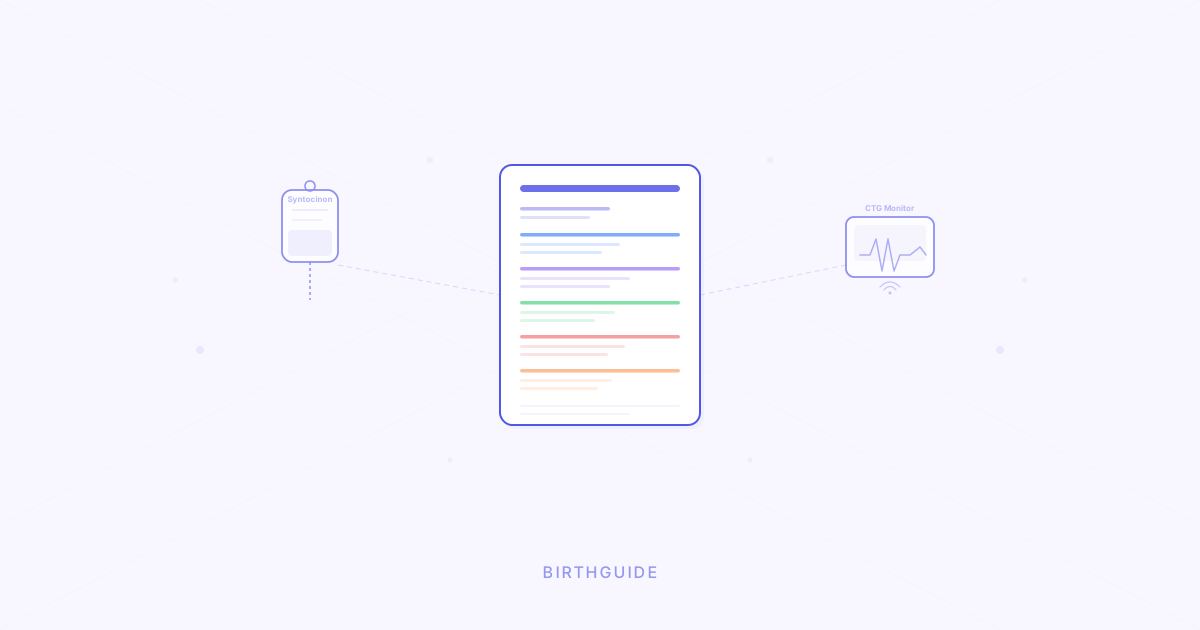
This is the biggest practical change. Once you are on a syntocinon drip, most Australian hospitals require continuous fetal monitoring (CTG). This means a belt around your abdomen tracking your baby's heart rate and your contractions. Standard CTG limits your ability to move around the room.
Your birth plan should note whether you would like wireless monitoring if it is available. Wireless CTG lets you stand, use a birth ball, sway, or move to different positions while still being monitored. Not every hospital has wireless equipment, so ask about this at your pre-induction appointment.
During the early stages of induction (before the syntocinon drip), monitoring is usually intermittent, so you may have more freedom to move during that phase.
Your mobility
A syntocinon drip requires an IV line in your hand or arm, and continuous monitoring requires the CTG belt. Both restrict movement compared to spontaneous labour. You are not confined to bed, but your range is limited by the length of the IV line and the CTG cables (unless wireless).
Despite this, you can still change positions. You can sit upright on the bed, lean over the back of the bed, use a birth ball next to the bed, stand beside the bed, or lie on your side. Note your preferred positions in your birth plan so your midwife can help you stay as mobile as possible within the constraints.
Pain relief timing
Induced contractions, particularly those driven by a syntocinon drip, often build faster and feel more intense than spontaneous contractions. Many parents who planned to manage without an epidural find they want one during an induced labour. This is not a failure. It is a normal response to a different type of contraction pattern.
Your birth plan should reflect this honestly. Something like: “I would like to start with gas and non-pharmacological methods. I am open to an epidural if contractions become difficult to manage.” That gives your care team a clear starting point without locking you into a decision.
If you know you want an epidural from the start, say so. If you want to avoid one for as long as possible, say that too. The point is to write down your informed preference rather than making the decision for the first time mid-contraction.
What stays exactly the same
Here is the part that matters most, and the part most induction guides skip. A large portion of your birth plan applies regardless of how labour starts.
Your birth environment. You can still request dim lighting, music, quiet voices, minimal interruptions, and aromatherapy. The room you are induced in is still your birth space. Setting it up to feel calm and private supports your body's oxytocin production, which works alongside the syntocinon drip rather than against it.
Who is in the room. Your support people, your preferences about students or extra staff, and your partner's role are all unchanged.
Pain relief options (beyond the timing question). Gas (nitrous oxide), sterile water injections, heat packs, massage, TENS machine (before the syntocinon drip starts), and breathing techniques are all still available to you during an induction.
Pushing and delivery. Your preferences for pushing positions, coached vs body-led pushing, warm compresses on the perineum, and whether you want to touch your baby's head during crowning are all the same whether labour started spontaneously or was induced. If you have an epidural, your position options are more limited, but you can still push on your side or with the bed upright.
Third stage. Delayed cord clamping, physiological or active management of the placenta, cord blood banking, and keeping the placenta are all unaffected by induction.
Baby's first moments. Skin-to-skin, uninterrupted bonding time, feeding preferences, vitamin K, and who stays with baby if you are separated. All of these are the same.
Your caesarean backup. Induction carries a higher chance of progressing to a caesarean than spontaneous labour, particularly for first-time mothers. Your birth plan should include your caesarean preferences just as it would for any vaginal birth plan. Our caesarean birth plan guide covers what to include.
Questions to ask before your induction
Bring these to your pre-induction appointment or discuss them with your care team when induction is first recommended.
- Why is induction being recommended, and how urgent is it?
- Can I wait a few more days, or does it need to happen now?
- What method of induction will be used first?
- How long does the process usually take at this hospital?
- Will I need continuous monitoring throughout, or only once the syntocinon drip starts?
- Does this hospital have wireless CTG monitors?
- Can my partner stay with me overnight if the induction takes a long time?
- What happens if the induction does not work?
The answers to these questions will shape your birth plan. An induction that starts with a balloon catheter overnight has a different set of practical considerations than one that starts with breaking your waters in the morning.
Writing your induction birth plan
Your birth plan should cover the same sections as any birth plan, with a few additions specific to your situation.
At the top, note that you are being induced and the reason (this gives context to any new staff who read the plan). Include your monitoring preference (wireless if available), your pain relief approach (acknowledging that induction contractions can be more intense), your mobility preferences (positions you want to try within the constraints of the IV and CTG), and everything else you would include in a standard plan: environment, pushing, third stage, baby care, caesarean backup, and communication preferences.
For a full overview of what goes in each section, our complete birth plan guide covers every section in detail.
BirthGuide's questionnaire covers all of these sections. Your generated birth plan includes your preferences for pain management, monitoring, environment, and backup scenarios in a single colour-coded document. Whether you are being induced or going into labour spontaneously, the document works the same way. Your partner gets a one-page cheat sheet with your key priorities.
Create your birth plan